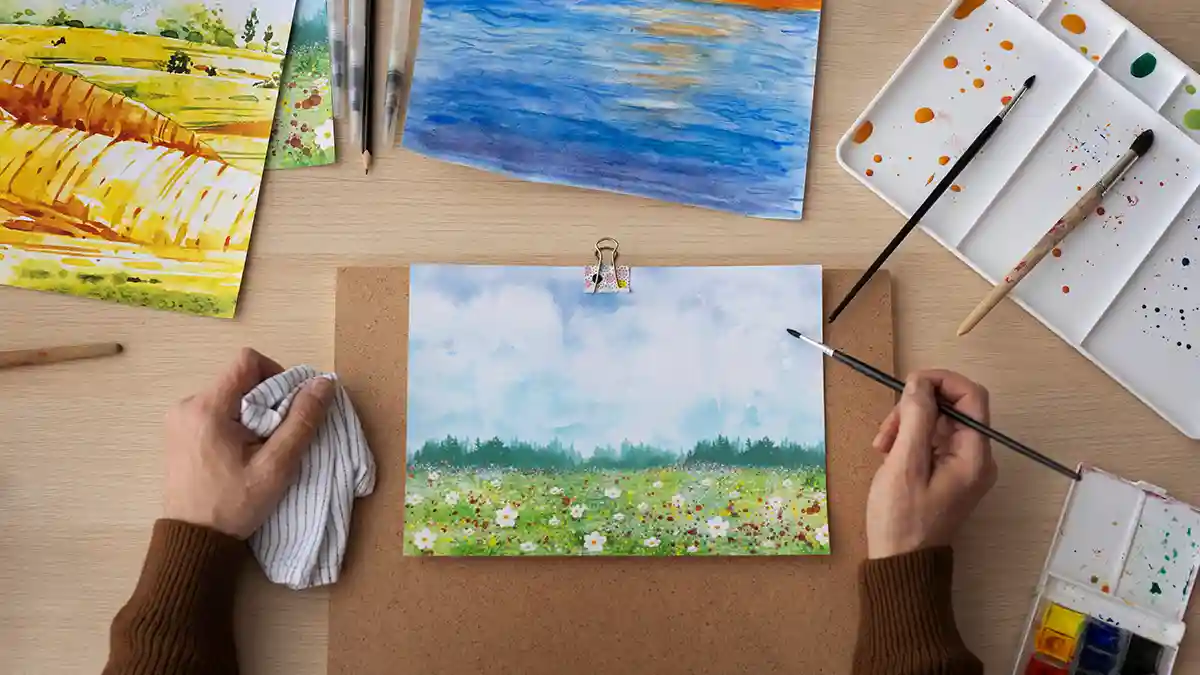
Do you ever find yourself staring at some artwork and being mesmerized by all the different shades and tones blending together effortlessly? These blended colours seem to take on a magical aura as if they could just move across the surface of the paper. This is the magic and beauty of watercolor drawing.
What’s so appealing about watercolors is their ability to be both simple and complex in the same piece of art. The only things needed to create an extraordinary piece of artares water, paint, and paper.
The perceived difficulty associated with painting with watercolor often creates anxiety for many beginners. It is because they believe they are no longer in control of the paint. But learning a few basic techniques can help build their confidence substantially. In this blog today, you will get to learn 5 easy steps to master the basics of watercolor drawing.
1. Learn the Basics of Watercolor Drawing
The first thing you must know is how watercolor works. Once you know it properly, then drawing with watercolor becomes a fun thing to do.
When you use water and paint together, it causes the watercolor to flow evenly. The amount of water you add to the paint will determine how light, dark, transparent, or opaque the painting will be.
Why Watercolour Painting is Unique?
Watercolour differs from oil and acrylic painting by retaining its transparency.
Unlike oil and acrylic, thick layers cannot completely cover most mistakes when using watercolour paint. Hence, making decisions early in your watercolour drawing process will help you plan for and ultimately control your results.
Patience is a virtue when painting in watercolour; each layer needs to dry completely before adding any additional paint. If you do not wait for the previous layer to dry properly before applying the subsequent layer, you will inevitably create unwanted colour mixing as you apply successive layers.
Essential Supplies
There is no need to spend a fortune on your supplies to begin painting in watercolours. Starting off with the most basic supplies will suffice. Quality paper has a more decisive influence on a watercolour painting than the actual paint itself.
| Material | Why Does It Matter | Tip for the Beginner |
| Watercolour Paper (300 GSM) | Prevents warping | Select cold-pressed paper |
| Basic Paint Set | Core primary colours | Avoid using cheap paints |
| Round Brushes | Versatility and good control | Start with size 6 or 8 |
| Cloth/Tissue | Control water | Blot extra water gently |
| Water Jar | Rinsing brush | Keeps two jars |
The key to a smooth and enjoyable first-time experience of painting with a watercolor brush is having good materials.
2. Learn the Basic Techniques of Using a Watercolor Brush
The only way to become proficient at painting is by practicing fundamental techniques. Take some time to learn how your brush moves and how to manipulate water on your page.
Wet-on-Wet Technique
With this technique, you paint onto wet paper, and the paint will flow and allow for beautiful blending of colours. Many artists use this technique when creating a sky, a background, or an abstract painting.
By using this technique when painting, you create a soft-edged, dreamy, and flowing look to your finished painting.
Wet-on-Dry Technique
In this technique, you apply paint to dry paper. It creates strong edges and allows for greater control over the paint. This technique is good for creating detail in leaves, buildings, and outlines.
By using both of these techniques in your work, you can create a lot of contrast between the two.
Mixing Colours
You do not need to have a huge collection of paint tubes. Just use the primary colours to create secondary colours.
For example, if you mix blue and yellow, you will get green. If you mix red and yellow, you will get orange.
Before you begin your production painting, you should always practice small exercises to check your mixing. With time and practice, you will have a better knowledge of how to mix your colours and your finished painting will appear more natural.
3. Practice with Watercolor Sketch
Next, you start putting paint on paper. It is best to begin painting small objects; you should not paint an entire landscape at the start, but work with simple objects like fruits, flowers, and cups.
It is better to use a light pencil outline; use a soft pencil. Remember that your outline is just a guide; the ‘watercolor sketch’ will be your guide to painting, but not the command of the painting.
Every Object is Made up of Basic Shapes
Find the various basic shapes that make up the object you are painting.
For instance, an apple is just a round shape, whereas a house is made up of a rectangle with a triangle roof on top. When you break the object down into basic shapes, it is much easier to draw.
After you have outlined the object, you will want to paint a light wash; let it dry before you add any shadows or detail.
Layer Very Slowly
By layering, you add depth to your drawing; add thin layers; do not use thick layers. Always allow each layer to dry before adding the next. This will help keep your colors from becoming muddy.
By practicing consistently, you will gain more control and confidence in watercolor drawing.
4. Improve Brush Balance and Water Control
Water control will decide how well your paint will flow; if you put too much water on an area, it will create a bleeding effect. If you don’t put enough water on an area, it will have a very dry and rough-looking stroke.
Understand Water-to-Paint Ratio
| Water Level | Result | Best For |
| Very Watery | Light, transparent wash | Backgrounds |
| Thick Paint | Bold, deep colour | Shadow and details |
| Medium | Balanced tone | Main objects |
It is better test your combination first with some scraps of paper.
By learning to control your water, you will be able to enhance your abilities with watercolor drawings.
Learn to Control Your Brush Pressure
Use less pressure on the brush to create finer detail than using lots of pressure to create bolder details; hold the brush towards the middle of the handle for added control.
Practice daily for developing muscle memory. As little as a 20-minute daily exercise will help develop your skills a lot.
5. Explore Creativity
Now that you understand the fundamentals of watercolors, it’s time to test your creativity and explore. Get inspired by looking at different ‘watercolor drawings’ you find online. Find different examples of how artists have used light and shadow in their work and how they create highlights by leaving white space.
Creating Texture and Detail
Use different techniques while creating texture.
For example, you can create roughness by using a dry brush, or sprinkle some salt onto a wet painted surface to develop interesting patterns, or when painted color is applied, you can also lift color from the surface using a damp brush to create a highlight.
Experimenting with your creativity will help to keep it creative and personal for you, so that you can develop your unique style of ‘watercolor drawing’.
Trying Out Various Design Styles
If you are looking for a loose style of painting, or you would prefer to paint in the most realistic way possible, or if you are seeking a simple and minimal way of planning out your art, you still have options available to you.
You may also want to consider experimenting with different styles of watercolor drawing by combining ink with watercolor. Using these two mediums together creates bold outlines with soft coloured-in areas, giving a more fluidical movement through your art.
If you want to create your art in a flowing or fluid way, try painting your ‘watercolor drawing’ without first outlining your drawing with any hard lines, and let your paintbrush take you along your path.
Common Mistakes You Must Avoid
- Do not saturate the watercolor paper with too much water at once.
- Don’t be afraid of making mistakes; every time you make a mistake, you learn.
- Create a daily practice schedule. Work on small subjects every day, focusing only on one specific type or technique of painting.
The Benefits of Watercolor Drawings
Art relaxes you, and painting will reduce stress, help you concentrate, and improve your creativity.
Practicing watercolor drawing also increases your hand-eye coordination and teaches you to observe detail.
You don’t have to have a studio or expensive equipment for painting. You can do it in your home, at the park, or while you travel.
Because of this, watercolor is one of the most versatile types of art.
Improve Your Skills
After you become more confident in painting, you will be able to mix your colors to create new shades instead of just using the colors found in the pans. Learning the basics (such as combining blue and orange to form a sophisticated shade of gray) will completely change your approach to your artwork. You will see that once you have mastered the basics of using water and color, the possibilities of creating watercolor drawings are limitless.
Many artists consider the watercolor drawing method a relaxing, therapeutic break from their hectic lives. Because creating layers takes time as they dry, this sslowdownallows one to practice mindfulness.
It is impossible to hurry up the water, so you can only create at its pace. The back-and-forth rhythm between water and color makes this activity pleasurable to both your mind and soul. The key is to keep practicing and continue exploring everything about yourself, and having fun with the process.
Conclusion
You need time to grow and develop your basic artistic skills, but the experience can be very rewarding. Each of the 5 steps described above is essential for you to consider and practice thoroughly if you really wish to improve your skills.
Each attempt will help you achieve your goal of becoming the artist you want to be. When you make a mistake, it is often just an opportunity to learn something new about your materials. So pick up your brushes, take a dip into the water, and start making some wonderful artwork!
FAQs (Frequently Asked Questions)
Q1. Can someone paint a good water-based drawing who has never painted before?
No, because one needs to practice a lot before being able to paint a good watercolor drawing.
Q2. How might I become proficient at water-based painting quickly?
Practice every day while also focusing on controlling water.
Q3. What are water-based painting sketches?
They are sketches made from a light pencil before adding color.
Q4. Can I use inexpensive supplies to create a painting using water-based painting?
Yes! Basic paper/brush/paint will do fine, provided you have enough time to create a few paintings with them.
Q5. Is painting using water better than acrylic painting?
It depends on what you like; because of their characteristics, water-based painted images tend to appear softer than acrylic ones.