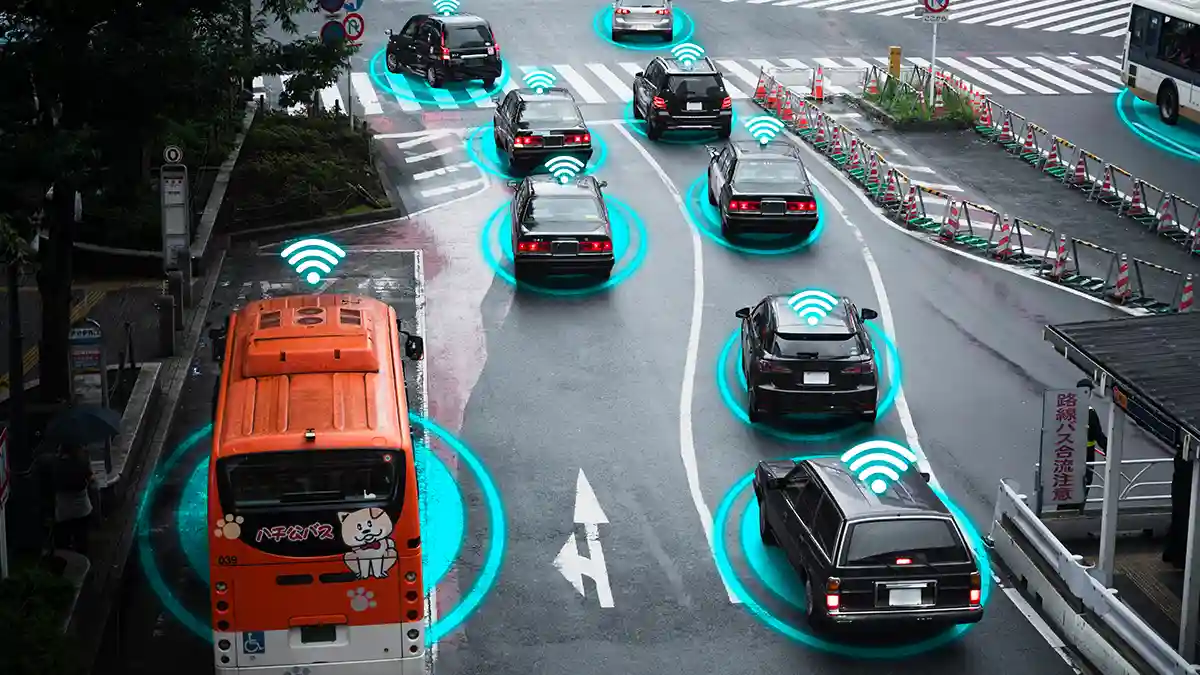
Hello Readers! Every single day, thousands of people get in their cars without much thought behind it as they rely heavily on their instinctual responses, traffic signal signs, and the reliability of other drivers. Unfortunately, around the world, the majority of all road accidents occur due to human error. This is why the future is Autonomous vehicles.
These vehicles do not get tired from driving, send/receive text messages while driving, or lose focus on you. We are no longer talking about sci-fi movies but rather about future reality. Self-Driving Cars, artificial intelligence is at the centre, will change how people travel around the world. AI will not panic, drink and drive, or take too long to perform calculations, make predictions, or respond to an event; it will do this all in milliseconds.
In this blog, you will learn how AI systems can help to reduce accidents from occurring. You will also explore how Autonomous vehicles are currently being developed and tested for real-world use.
The Problem: Human Error Causes Most Accidents
Most road accidents happen due to human error, not due to an issue with the actual road and infrastructure. Some examples of incorrect driving include misjudging distance, driving while distracted (e.g., texting), or responding too slowly during an emergency (i.e., an accident).
Statistics show that human error causes over 90% of all road accidents around the world. Hence, when you eliminate the human error factor from driving, you eliminate most of the accidents.
The purpose of self-driving cars is to eliminate the human error factor in driving.
How does AI Power Autonomous Vehicles?
AI and the framework that controls autonomous vehicles are heavily reliant on data collection, the analysis of a vehicle’s surroundings, as well as providing real-time instant decision-making.
Sensors See Everything
Self-driving vehicle systems utilize many different sensing systems to monitor their environment (Cameras, Radar, Lidar, Ultrasonic). This is how it determines the location of any nearby vehicles, pedestrians, road signs, and Lane markings.
The data obtained from all of the aforementioned sensors is calculated and acted upon by an AI system in real-time. Further, the AI system constructs a real-time map of the environment. Humans use their eyesight and mirrors for every aspect of their driving, and the AI will utilize a 360-degree view of its surroundings in daylight or nighttime.
Machine Learning Predicts Behaviour
AI can do much more than simply detect objects; it also predicts movements.
For example, if a pedestrian is standing at or near a crosswalk, the system anticipates what may happen if that pedestrian chooses to cross. If another vehicle drifts a bit out of the travel Lane, the AI will brace for the possibility that the vehicle may change Lanes without signaling.
Predictive capabilities of the AI play a significant role in reducing collision risk. It is because the AI always analyzes moving patterns without the benefit of distraction, as human drivers have.
The Reaction Rate of Autonomous Vehicles
The reaction time is an important factor in preventing accidents. Human drivers take approximately 1.5 seconds to respond to an imminent threat. When driving on a freeway/expressway at highway speeds, 1.5 seconds converts into 10s of meters before they apply their brakes.
On the other hand, AI reacts in milliseconds. They have the ability to instantly calculate the distance required to stop the vehicle. Additionally, they are able to instantly apply the brakes or adjust the steering before a human can react.
Finally, self-driving cars reduce the impact of a collision by minimizing reaction times.
Eradicating Drunk and Distracted Driving
Drunk driving and distracted driving are responsible for thousands of fatalities every year. Neither the many awareness campaigns nor the new laws have entirely solved the problem.
AI does not drink. AI does not text. AI does not become unfocused.
Self-driving cars operate based on constant data collection and algorithm-based decision-making. They do not experience emotional stress or road rage.
Advanced Driver Assistance Systems as a Transition to Full Autonomy
Before full self-driving vehicles become widely available, existing vehicles have some aspects of automation today.
Lane Keeping Assist
These systems monitor the lane marking and can slightly assist with steering to stop the vehicle from breaching the lane. The driver has ultimate control over the vehicle, but AI is supporting a safe outcome.
Automatic Emergency Braking
These technologies will automatically brake the vehicle when detecting an imminent collision. This capability has already prevented many accidents.
These technologies are a form of early autonomous vehicle logic operating in conjunction with a human driver.
AI Decision-Making in Complex Environments
Navigating urban roadways is not a simple task; pedestrians are frequently unpredictable. Cyclists can rapidly come into your line of sight, and traffic signals are often changing very quickly.
AI analyzes many different sources of data very quickly at the same time (speed, direction, traffic laws, and the distance to any obstacles, etc.)
Multitasking can create difficulties for human drivers who develop under high levels of stress, while AI can process large amounts of data instantly.
Real-World Testing and Data Collection of Autonomous Vehicle Technology
Testing of self-driving systems is conducted over millions of kilometers and collects data from many different types of driving environments (highways, city streets, rural roads, and extreme weather conditions).
AI will continue to learn from all of these driving scenarios and use the results of each test to improve upon future driving decisions.
Engineers constantly refine the algorithms. By simulating rare crash situations in controlled environments, the ongoing learning helps to improve safety.
Self-driving cars will continue to receive software upgrades to continue their development as they learn from all of these tests.
Reducing the Number of Collisions at Intersections
Intersections are the most dangerous areas to drive in, as human drivers often misread signals, run red lights, or fail to give the right of way to another vehicle.
AI can monitor traffic signals as well as the vehicles that are approaching the intersection simultaneously in order to use an efficient and consistent method of stopping.
As multiple Autonomous vehicles are able to communicate with each other via a connected network, they will better coordinate their movements and reduce confusion and collisions.
Vehicle-to-Vehicle Communication
Safety in the future is dependent on communication.
Enhancing Safety with Communication
Communication-equipped vehicles will exchange information about how fast they are going, when they stop, and any road dangers (e.g., ice or debris). If a vehicle finds ice or debris, it will send out a signal to warn other vehicles to stay clear.
This effect creates a shared awareness of dangers to multiple vehicles instead of having each vehicle react on its own through cooperation.
Autonomous vehicles will benefit greatly from their huge amounts of shared knowledge.
Technical Challenges and Ethical Considerations
Technology faces many hurdles. Engineers must find ways to make ethical choices when developing systems that may operate under unpredictable human influence during rare occasions of accidents.
The developer community continues to conduct extensive testing on edge cases and implement techniques to improve reliability. Public trust and regulation will play an important role in aiding the widespread acceptance of these technologies.
However, development continues at a steady pace.
Every year, self-driving cars will continue evolving and will have advanced as a result of improved software and hardware integration.
Public Confidence and Trust
Individuals often have an initial level of apprehension surrounding the relinquishment of control to a machine, but developing trust in a system that may have a significant amount of time and history behind it will generally provide an individual with comfort.
As the number of positive case studies increases, so too does the level of public confidence. Additionally, early adopters are finding that travel using Automated Vehicles is less stressful than travelling through traditional means.
As more people see a continual improvement in safety levels, industries implementing Self-driving vehicles will be able to market their use.
The Future
Experts project an incremental adoption of Autonomous technologies as opposed to a replacement of manual vehicles overnight. At first, hybrid operating systems will be the norm, with AI-operated and human-operated vehicles continuing to operate on the same roadway for several years.
Each software update enhances performance in terms of the safety aspects of the vehicle, which will assist in building confidence in the vehicle’s automated driving functions and producing evidence of safety improvement.
Ultimately, self-driving cars will contribute to an enhancement of Intelligent Mobility for the future.
Conclusion
For all of history, mankind has had to deal with the serious problem of auto accidents, most of which occur due to human error. Advances in Artificial Intelligence can provide an effective solution by eliminating drivers’ distractions, reducing fatigue, and preventing emotional-based decisions from affecting an individual’s ability to drive.
The advent of autonomous vehicles (AVs) will significantly reduce the likelihood of getting into an auto accident due to the application of advanced sensor technology, powerful algorithms to predict future outcomes, instant communication, and the capability for the vehicle to continually learn.
Nevertheless, while many challenges still exist for AVs to be accepted into society, the continual progress made on their development is constantly moving forward.
Although AVs will not completely eliminate danger from driving, they will have a tremendous impact in making the roads much, much safer than ever before; if technology is embraced responsibly by people, we may one day find that traffic accidents have become infrequent occurrences instead of everyday tragedies.
FAQs (Frequently Asked Questions)
Q1: Are self-driving vehicles completely free of accidents?
No, but autonomous vehicles create fewer accidents than conventional vehicles operated by human drivers.
Q2: How is AI preventing car crashes?
AI can see its surrounding environment in real-time and respond quicker than humans can.
Q3: Will self-driving vehicles fully replace human drivers?
Yes, it is possible that self-driving cars will begin to eliminate some of the need for human-operated vehicles over the years.
Q4: Are these cars safe to operate in bad weather?
They are safe to operate in all types of weather, and engineers continue working to improve their performance.
Q5: When will we see a growth of fully autonomous vehicles?
In the next 10 years, you can expect to see growth and development.